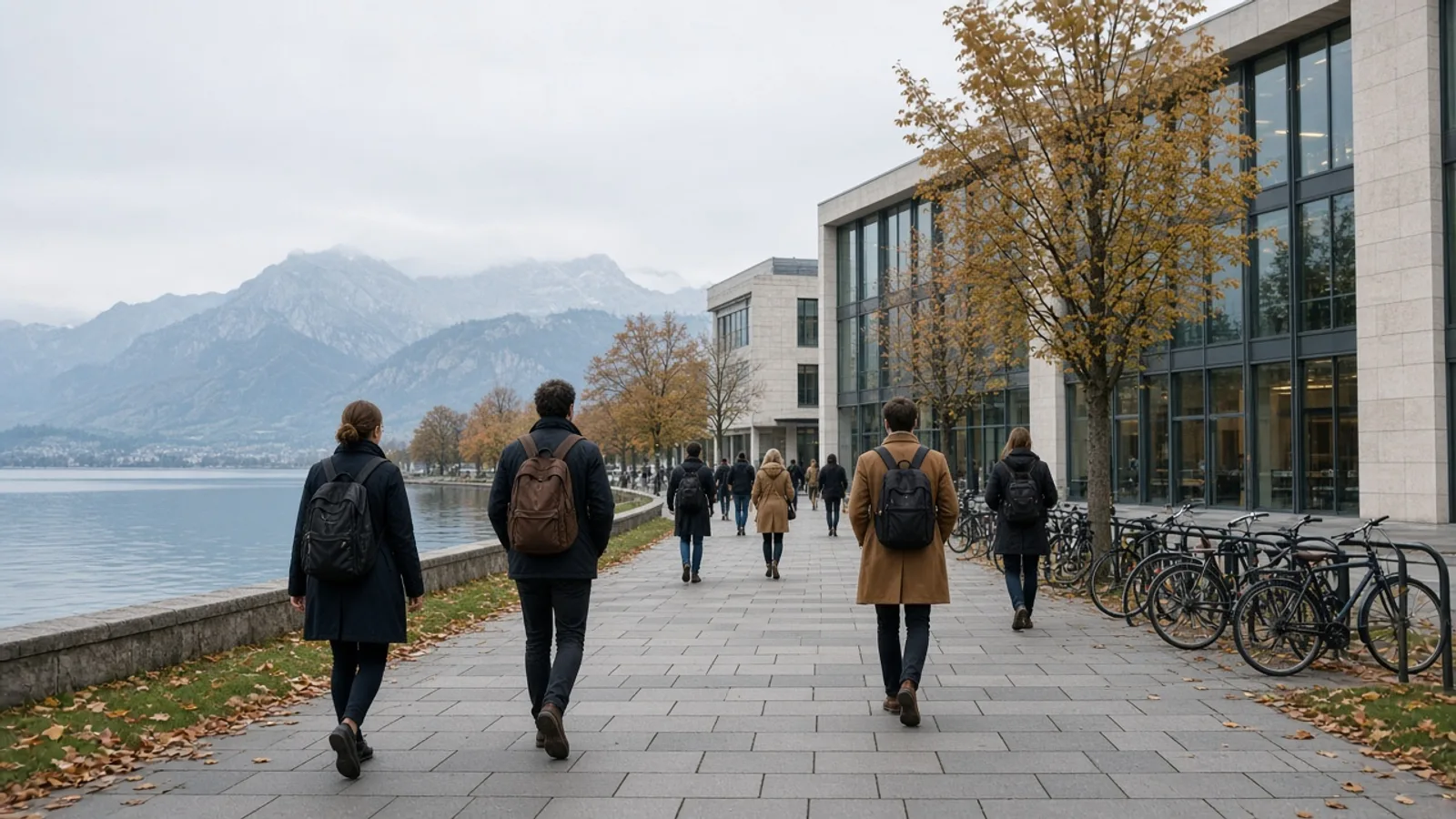
Switzerland can be a tempting place to study. Research laboratories, multilingual cities, universities with international reputations, mountains visible from the train on an ordinary Tuesday. It’s an easy picture to fall for. Paying for the picture, and getting admitted to the programme behind it, is another matter.
The first thing to understand is that Swiss higher education isn’t a single system with a single admissions desk. There are different types of institutions, different academic routes and substantial differences in what students actually spend. The choice of degree matters. So does the city, the language of instruction and, for an international applicant, the status of the institution issuing the qualification.
A little research before paying an application fee can save a spectacular amount of trouble.
Contents
The Swiss Higher Education Landscape
Switzerland’s higher education sector includes traditional universities, federal institutes of technology, universities of applied sciences and universities of teacher education. They share an academic landscape, but their purposes aren’t identical. A laboratory-based research degree and a professionally oriented master’s may both be demanding qualifications; they are built around different expectations.
Traditional universities have a strong academic research mission. That includes the two federal institutes of technology, ETH Zurich and EPFL, which are prominent in science and engineering. Universities of applied sciences place greater emphasis on professional preparation and applied research. Teacher education institutions specialise in preparing educators, with their own study structures and admission pathways.
| Institution type | Broad academic emphasis | What applicants should investigate |
|---|---|---|
| Traditional university or federal institute of technology | Academic disciplines, research, bachelor’s and master’s study, doctoral work | Research groups, programme prerequisites, supervision, language and degree requirements |
| University of applied sciences | Profession-oriented study and applied research | Work-experience expectations, industry projects, programme structure and routes to further research |
| University of teacher education | Teacher preparation and educational development | Teaching credentials, language requirements, placements and eligibility for professional practice |
The distinction is especially important at doctoral level. In the Swiss system, doctorates are awarded by universities and the federal institutes of technology, although researchers from applied-sciences institutions may participate through cooperative arrangements. Don’t assume that every school offering a postgraduate-sounding programme has the authority to award a Swiss doctorate. Our guide to academic research doctorates looks at that research path more closely.
A Swiss Master’s Degree Is More Than a Country Label
Master’s programmes in Switzerland range across business, economics, computer science, engineering, law, social sciences and the arts. The usual questions still apply. What will you study? Who will teach it? Is a thesis required? Are there internships or projects, and what is actually assessed?
A country’s reputation won’t answer those questions for you.
Business education deserves a separate look. An MBA typically targets management practice and professional experience; a specialised master’s may be designed for deeper study of a particular discipline. Swiss institutions also offer continuing education qualifications with names such as MAS, DAS and CAS. These can be valuable, but they aren’t automatically interchangeable with an ordinary consecutive academic master’s degree. Read the qualification description, not just the letters printed on the brochure. The comparison of an MBA and a specialist master’s is worth making before the application, not after.

The Language Question Comes Earlier Than You Think
Switzerland has several national languages, and study options differ by institution, region and level. German, French and Italian appear across the higher education system. English is common in some graduate programmes, especially certain research-oriented and international offerings, but its availability must never be assumed.
Check the specific programme’s language-of-instruction rules, the accepted evidence of language proficiency and whether a thesis may be written in English. If laboratory work, placements or professional practice are included, ask about language expectations there too. This is no small detail for a student hoping to work locally after graduation.
Admissions: Your Previous Qualification Matters
Swiss higher education institutions make their own admission decisions according to their regulations. There is no universal approval stamp guaranteeing entry everywhere. Foreign qualifications are assessed in context, and requirements may differ across programmes at the same institution.
For a master’s, applicants commonly need a relevant prior degree and academic transcripts. Some programmes require particular subject credits, an acceptable grade profile or evidence of language skills. Portfolios, entrance assessments, professional experience or recommendations can also enter the picture. Doctoral applications may depend on a research proposal, appropriate supervision and evidence that the applicant can undertake independent research.
Prepare your documents early. Transcripts, degree certificates and official translations can take longer to obtain than the online application itself. Names and qualification titles should match across records. A missing document discovered on the deadline day is an infuriating way to lose a promising opportunity.
What Does Studying in Switzerland Actually Cost?
There’s an odd mismatch in the Swiss study conversation: tuition at some public institutions can appear relatively modest, while the cost of living looks anything but. Both figures matter. University fees vary by institution, programme, study level and sometimes student category, with additional charges for certain international students.
And tuition isn’t the complete price of studying.
Housing often becomes the dominant monthly expense, especially in cities with tight rental markets. Health insurance, food, transport, study supplies and residence-related costs must be included too. A low semester fee doesn’t make rent disappear. Nor does a scholarship automatically cover every bill.
Build a budget using the exact city and programme, rather than a broad national average. Ask the institution what its published tuition includes, whether non-Swiss students pay a supplement, when fees are due and what happens if your programme takes longer than expected.
| Budget item | Why the amount can vary | What to check before applying |
|---|---|---|
| Tuition and semester charges | Institution, programme, degree level and student category | Current official fee schedule and mandatory extras |
| Housing | City, neighbourhood, shared or private accommodation | Deposits, utilities and realistic availability |
| Health insurance | Individual circumstances and possible exemption eligibility | Applicable insurance and residence requirements |
| Food and transport | Lifestyle, commuting distance and student discounts | A monthly budget based on actual local costs |
| Application, travel and setup costs | Documents, relocation, permits and initial purchases | Up-front cash needed before the first semester |
Scholarships and Doctoral Funding
Scholarships are available through a mixture of institutions, research projects and funding bodies. Availability and eligibility differ sharply. Some funding is aimed at master’s students; other opportunities support doctoral researchers or specific academic fields. Many students will not qualify for a fully funded package.
The Swiss Government Excellence Scholarships are a useful example of why the details matter. They focus mainly on eligible international researchers, with separate arrangements for certain arts applicants. They are not a general scholarship covering every undergraduate or taught master’s applicant. Research-oriented applicants generally need a suitable Swiss academic supervisor and must satisfy country-specific conditions.
Doctoral financing also deserves care. A funded research position, an externally financed doctorate and a scholarship are not the same arrangement. One may involve employment responsibilities, another a stipend, and another limited support for a defined period. Ask what happens to funding if a thesis takes longer, whether tuition still applies and how supervision is organised.
Student Visas, Residence and Part-Time Work
International students don’t all follow the same immigration process. Nationality, the length and purpose of study, the selected institution and the relevant Swiss authorities affect what documents and permissions are required. Students from outside the EU/EFTA often face additional visa or residence procedures and may need to show adequate financial resources.
An admission letter is an important part of the process. It isn’t a promise of a residence permit.
Likewise, being a student does not create an unrestricted right to take a job in Switzerland. For students from non-EU/EFTA countries, supplementary work may be authorised subject to conditions, limits and employer involvement. Rules about when such work may begin and the permitted hours are not something to guess from a message board. Confirm the current position with the appropriate migration authority and institution before relying on earnings in your budget.
Accreditation: Where the Word “Swiss” Stops Helping
A Swiss address is not proof of Swiss university status. Nor is a polished website, a grand-sounding degree title or an impressive photograph of a building. Switzerland regulates protected higher-education designations and has an institutional accreditation system. Applicants should distinguish a recognised higher education institution from a private training provider and examine the actual status of the degree-awarding body.
The Swiss Accreditation Council is responsible for institutional accreditation decisions under the Higher Education Act. The public list of accredited institutions maintained by swissuniversities is a useful starting point. If a provider’s claims are unclear, verify them through the relevant authorities and the institution itself rather than trusting a logo on a recruitment page.
Private education is not automatically worthless, of course. It may serve legitimate professional learning needs. The issue is what qualification is being offered, who awards it, whether it carries the academic status you need and how it will be evaluated for the purpose that matters to you. Those questions become urgent when a degree is intended for doctoral admission, regulated professional practice or employment abroad.
Online Study and Cross-Border Recognition
Some learners want a Swiss educational programme without relocating. That can be practical, but distance learning brings its own complications: required campus visits, examinations, supervised research, teaching schedules and access to student services. A label such as “online” does not tell the whole story. Our distance learning guide covers those timetable and recognition checks in more detail.
Also separate the location of the provider from the status of the award. An organisation teaching from Switzerland may deliver a qualification awarded elsewhere. Before paying, identify the degree-awarding institution and the exact award on the final certificate. Then consider whether the qualification will meet your future academic or professional needs in the country where you plan to use it.
Before You Commit to a Programme
You don’t need a fifty-page spreadsheet to make a sensible choice. You do need answers to a handful of awkward questions: Is the institution properly recognised for the qualification it offers? Who actually awards the degree? Can your prior studies qualify you for admission? What language will your work really require? What is the total cost after housing and compulsory expenses? And where could the qualification take you afterward?
Switzerland offers serious opportunities for academic and professional study, but there is no universal Swiss programme that suits everyone. The good choice is the one whose requirements, funding, academic purpose and future recognition hold up under close inspection. Place those checks beside the wider map of graduate studies in Europe, including Study in Germany and Study in France, rather than treating a country name as the whole decision.
Frequently Asked Questions
Can international students apply to Swiss universities?
Yes. Swiss institutions admit international applicants, but eligibility is decided under the institution’s and programme’s rules. Prior qualifications, subject prerequisites, languages and country-specific conditions can affect admission.
Is studying in Switzerland inexpensive because some universities charge relatively low tuition?
Not necessarily. Tuition varies, and living costs can be substantial. Housing, insurance, transport, deposits and other charges belong in the same budget as semester fees.
Can I study for a master’s degree in English in Switzerland?
Some master’s programmes are taught in English, but availability differs by institution and field. Confirm the teaching, assessment and thesis-language requirements of the exact programme you want.
Are Swiss Government Excellence Scholarships available to every master’s student?
No. These schemes focus mainly on eligible international researchers, with certain arts scholarships under specific conditions. Ordinary taught master’s applicants should also examine funding offered by individual institutions.
Does a degree from a private school based in Switzerland automatically count as a Swiss university degree?
No. A Swiss address and private-school branding do not establish university accreditation or degree recognition. Check the awarding institution, its academic status and whether the qualification meets your intended purpose.